Wednesday, January 18, 2012

Global Warming, An Introduction


From the term itself, global warming refers to the observed and projected increases in the average temperature of Earth’s atmosphere and oceans. Between 1906 and 2006, the Earth’s average surface temperature rose between ranges 0.6 to 0.9 degree Celsius. The worse this is, for the last 50 years the temperature increase rate is almost doubling. Another term for global warming is climate change.  Global warming can have many different causes, but the primary issue is the release of excessive amounts of greenhouse gases in the atmosphere.


Carbon dioxide (CO2), methane (CH4), and water vapor are naturally occurring greenhouse gases in the atmosphere. Greenhouse gases present in the atmosphere is actually good in naturally occurring amounts or if it come naturally and not because of human intervention and human activities. Greenhouse gases trap the heat coming from the sun. Heat coming from the sun is absorbed by the Earth’s ocean, land and air. The more greenhouse gases there are present on Earth’s atmosphere, the larger the percentage of heat that is trapped inside the Earth’s atmosphere. Without the greenhouse gases, the Earth’s average surface temperature would be very cold. Greenhouse gases make life possible on Earth.
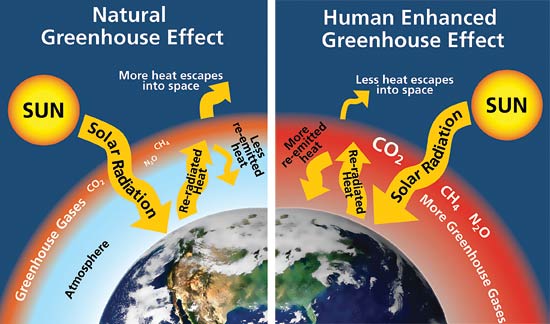

So, if greenhouse gases are good in the atmosphere, why is that it is believed as the main cause of global warming? The problem begins when people start contributing excessive amounts of greenhouse gases in the atmosphere. Excessive greenhouse gases in the atmosphere increases the natural temperature. Because as stated earlier, the more greenhouse gases there are, the larger the percentage of heat is trapped inside the Earth’s atmosphere. Over the last 100 years, the Earth has experienced the largest increase in the surface temperature. As the world continues to depend on using fuel energy, greenhouse gases in the atmosphere will continue to rise, comes with them is the Earth’s temperature. Another worse thing is, according to research, the average surface temperature on Earth could increase between 2° C and 6°C by the end of the 21st century.


If human activities that are causing these scenarios continue, we would expect a warmer temperature as years pass by.

IMAGES:

What is Ozone Layer?

Ozone is a natural gas containing three oxygen atoms rather than two oxygen atoms that we breathe. Ozone is found in two different layers of the atmosphere, in the troposphere and in the stratosphere. Ozone present in the atmosphere is good while ozone present in troposphere is bad.

The ozone layer is a deep layer in the stratosphere that protects life on Earth from the sun’s ultraviolet (UV) rays. The ozone absorbs a portion of the radiation from the sun, preventing it from reaching the Earth’s surface. Ozone layer also absorbs the portion of the sun’s harmful ultraviolet light called UVB. Too much UVB causes bad health such as skin cancer and eye damage among others. UVB also harms some crops, marine life, and some materials.


While the ozone present in the stratosphere protects life from the sun’s harmful ultraviolet light, ozone present in the troposphere causes breathing problems for some people. It is stated that chlorofluorocarbon (CFC’s) used as refrigerants, solvents, foam blowing agents, and in other smaller applications have atmospheric lifetimes long enough to allow them to be transported by winds into the stratosphere where radiation breaks them apart, releasing chlorine atoms. Chlorine can attack and break apart as many as 100,000 ozone molecules through a series of chemical reactions during the time it is in the stratosphere.

Countries around the world became increasingly concerned that chlorine from chlorofluorocarbons (CFC’s) could further deplete the ozone present in the stratosphere if production of chlorofluorocarbons (CFC’s) is still supported and is not minimized. Countries agreed to sign a treaty called the Montreal Protocol. This protocol helps humans reduce the production of chlorofluorocarbons (CFC’s) and also its use.

Based from what I have read, there was also another treaty before regarding the reduction of production of chlorofluorocarbons (CFC’s) and its use. But research after research, additional use of chlorofluorocarbons (CFC’s) has been discovered. But due to the alarming effects of too much chlorofluorocarbons (CFC’s) present in the atmosphere, another treaty is made to reduce the production of chlorofluorocarbons (CFC’s) and its use. With this treaty, environmentalists believe that ozone present in the stratosphere in the coming years will be equal to the amount present during the 1980’s.


After the year 1980, ozone hole continues to grow bigger. And this event will continue if human activities that lead to this also continue.

To better understand the Montreal Protocol you could read this file I downloaded: 


IMAGES:

Sunday, January 15, 2012

Climate Change

Climate change affects more than just a change in the weather, it refers to seasonal changes over a long period of time. It is the major, overriding environmental issue of our time, and the single greatest challenge facing environmental regulators. It is a growing crisis with economic, health and safety, food production, security, and other dimensions.


Video: Social Impacts of Climate Change


Here are the common causes of climate change in the Philippines:

1. Pollution
The pollution emanating from different industrial zones all over the country, vehicles, CFCs from our air-conditioned units and refrigerators, and burnt plastic damages the Ozone Layer that protects our planet from the heat of the sun and us humans, also adds significantly to the Global Warming we are experiencing now.

2. Deforestation
Deforestation due to "kaingin" or slash-and-burn farming, growing populace, and illegal logging is stripping our forests of the trees that protect us from floods and serves as a habitat to different animals, causing mudslide, soil erosion and landslide.


One example of climate change due to deforestation is the tragedy that Typhoon Sendong brought into the Cagayan de Oro province and places near them last December 2011. Few numbers of trees and plants can absorb the amount of rainfall that causes the water to flow in the communities below the mountain areas. After the incident it is evident that illegal logging was being practiced in that region because of the woods that they’ve found.


Typhoon Sendong aftermath


We need to change the way we produce and consume energy, significantly reducing our dependence on climate-damaging fossil fuels. This means saving energy and improving the efficiency of the way we consume energy, while significantly expanding in the share of green, renewable energy as well as tackling emissions from the transport sector. We also need to stop abusing the forests and stop using products that can contribute to the pollution we're experiencing today.


References:
http://www.unep.org
http://generalhowitzer.hubpages.com/hub/The-Causes-and-Effects-of-Climate-Change-in-our-Planet
http://www.stopclimatechange.net/
http://www.youtube.com/watch?v=aehff7PLG3k

Impact of Automobile Pollutants

"Driving a private car is probably a typical citizen's most polluting daily activity." - US EPA


photo by CStrickland1983's photostream
How do cars and trucks contribute to climate change?
Carbon dioxide emissions arise at nearly every stage of a motor vehicle's life - including extraction of raw materials and manufacturing of component parts - and through the combustion of gasoline and diesel fuels during vehicle use which accounts for the greatest share of vehicle-related carbon dioxide emissions. According to Gregory Homel, an eHow contributor the vast majority of automobile in the world burn some type of fossil fuel, usually gasoline, diesel or oil, in a combustion engine to produce the power needed to travel. When fossil fuels are burned they create pollution in form of greenhouse gases such as carbon dioxide, nitrous oxide and methane, which are released in muffler of vehicles. The vehicles we drive release over 1.7 billion metric tons of greenhouse gases into the atmosphere each year contributing to the global climate change. Each gallon of gasoline you burn creates 20 pounds of carbon dioxide, that is about 6 to 9 tons of carbon dioxide each year for a typical vehicle.

WHAT CAN I DO? 
  1. Walking and Biking. This is the most simple and easy way to help stop climate change and global warming. Walking and biking will not release carbon dioxide and because of that you are helping our environment. Change starts with us. 
  2. Use public transportation more often.  Taking the bus, the train or other forms of public transportation is like hitting two birds with one stone it can lessen the load on the roads and reduces one's individual greenhouse gas emissions by an average of 1600 pounds per year. 
  3. Purchase an efficient car.  The most important personal decision for global warming is the car you drive. The next time you buy a car, get a hybrid or choose the least polluting, most efficient car that meets your needs. Better gas mileage not only reduces global warming but also saves you money at the pump. 
  4. Drive Smart.  If all Americans maintained proper air pressure in their tires, nationwide gasoline use would decrease by 2%. A properly tuned engine could boost gas mileage from 4% to 40% and a new air filter can improve gas mileage by up to 10%.  
  5. Plant a tree. A single tree will absorb one ton of carbon dioxide over its lifetime. Shade provided by trees can also reduce your air conditioning bill by 10 to 15%.  

"Reducing global warming on the road is a shared responsibility... automakers, fuel providers, consumers, and various level of government can help solve the problem by addressing those aspects of carbon dioxide emissions they can control" - John DeCicco, author of the report Global Warming on the Road: The Climate Impact of America's automobile


References (for more information):

Debate on Climate Change and Carbon Dioxide Changes

I found a very interesting video on youtube in which former Vice President Al Gore debates that global warming is caused by changes in carbon dioxide concentration. However, expert climatologists and professors argues that the increase in carbon dioxide concentrations is not correlated with the increase in temperature in Earth. They say that the increase in carbon dioxide concentration is the product of the increase in temperature. 


The experts have debated, it's up to you to decide! 

Saturday, January 14, 2012

Potential Effects of Ozone Depletion

Ozone layer is a layer in Earth's atmosphere that is located in the lower portion of stratosphere. it absorbs Sun's high frequency ultraviolet light, which is potentially damaging to the life forms on earth. It is definitely very essential to all living things on Earth. This can be evidently justified by the following potential effects that might happen on Earth if ozone layer is depleted.

What will happen...?
Humans
The UV-B on Earth will increase and in effect, it would directly affect humans' health. people may have skin cancer and cataracts. Thus, increased UV-B may also result to the suppression of the human immune response system.
In addition, some research shows that a decreased ozone layer will increase rates of malaria and other infectious diseases.

Marine Ecosystems
"One study estimated that a 16 percent reduction in stratospheric qzone levels would produce a five percent loss of phytoplankton productivity, leading to a loss of approximately seven million tons of fish from the annual fisheries harvest."

Plants and Crops
"The life cycle of plants will change, disrupting the food chain."

Materials
"Synthetic polumers, naturally occuring biopolymers, as well as some other materials of commercial interest are adversely affected by solar UV radiation. Today's materials are somewhat protected from UV-B special additives. Therefore, any increase in solar UV-B levels will therefore accelerate their breakdown, limitng the length of tiome for which they are useful outdoors."

Consequences of Global Carbon Dioxide Changes

According to the Environmental Protection Agency of the United States of America, human activities that started since the Industrial Revolution in the 1700’s have increased the carbon dioxide concentrations in the atmosphere. These activities are the burning of oil, coal and gas, and deforestation. In 2005, it was observed that the global atmospheric concentrations of carbon dioxide were 35% higher than they were before the Industrial Revolution.


The drastic change in the concentrations of carbon dioxide has dreadful consequences to human health, climate, agriculture, and wildlife.

One of the consequences reported, according to BBC Weather Climate, is that it is very likely that hot extremes, heat waves, and heavy precipitation events will continue to become more frequent. It was also stated that by the second half of the 21st century, wintertime precipitation in the northern mid to high latitudes and Antarctica will rise. At the same time, Australasia, Central America and Southern Africa are likely to see decreases in winter precipitation. In addition, sea level rises because the sea absorbs the heat from the atmosphere, causing it to expand. It is also speculated that if the entire Western Antarctic ice sheet melts, the sea levels will raise by about 3.2 meters. Because of this, Tuvalu in the Pacific is already experiencing severe flooding which resulted to the islanders starting to leave the island.

Another consequence of the change in concentrations of carbon dioxide is in terms of agriculture. The crops produced around the world could significantly change due to climate change. Weather is a vital part in farming and the changes in temperature and precipitation is very important in sustaining crop growth.

Human health is also affected by climate change. The quality of the food, water, and homes are all-dependent on the climate and weather. If winters become milder, there is a danger that bacteria would no longer die-off seasonally during the prolonged cold spell. This means that disease would spread more widely. Heat waves, on the other hand, will increase the number of hot-weather related deaths. The prevalence of cardio-respiratory diseases will also increase due to the high level of ground-level ozone. In addition, it has been observed that cases of skin cancer have quadrupled in the last thirty years. Also, because of the increase in flooding, the spread of water-borne diseases and the growth of fungi are likely to prevail more.

However, not only humans are affected by climate change. Environmentalists are concerned with the adverse effects of climate change for plants and animals throughout the world. The biggest concern is how climate change will affect the habitats in which species lives. According to studies, if temperature rises by more than 1.5-2.5 C, twenty to thirty percent of plant and animal species will be at increase extinction. The main concern with species shifting from where they are now is that if climate change occurs very quickly, some wildlife may not be able to adapt and move quickly and some may not survive.

For more information on the consequences of changes in concentrations of carbon dioxide, kindly refer to the references listed below.

REFERENCES:
http://www.epa.gov/