
From
the term itself, global warming refers to the observed and projected increases
in the average temperature of Earth’s atmosphere and oceans. Between 1906 and
2006, the Earth’s average surface temperature rose between ranges 0.6 to 0.9
degree Celsius. The worse this is, for the last 50 years the temperature
increase rate is almost doubling. Another term for global warming is climate
change. Global warming can have many
different causes, but the primary issue is the release of excessive amounts of
greenhouse gases in the atmosphere.

Carbon
dioxide (CO2), methane (CH4), and water vapor are
naturally occurring greenhouse gases in the atmosphere. Greenhouse gases
present in the atmosphere is actually good in naturally occurring amounts or if
it come naturally and not because of human intervention and human activities. Greenhouse
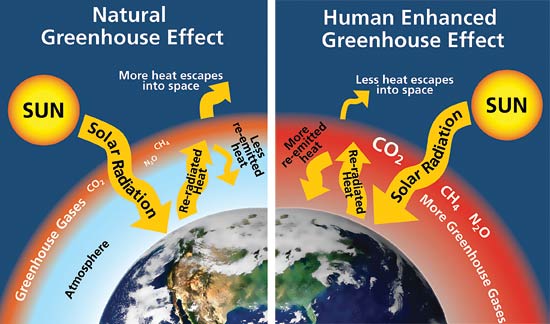
gases trap the heat coming from the sun. Heat coming from the sun is absorbed
by the Earth’s ocean, land and air. The more greenhouse gases there are present
on Earth’s atmosphere, the larger the percentage of heat that is trapped inside
the Earth’s atmosphere. Without the greenhouse gases, the Earth’s average
surface temperature would be very cold. Greenhouse gases make life possible on
Earth.
So,
if greenhouse gases are good in the atmosphere, why is that it is believed as
the main cause of global warming? The problem begins when people start
contributing excessive amounts of greenhouse gases in the atmosphere. Excessive
greenhouse gases in the atmosphere increases the natural temperature. Because as
stated earlier, the more greenhouse gases there are, the larger the percentage
of heat is trapped inside the Earth’s atmosphere. Over the last 100 years, the
Earth has experienced the largest increase in the surface temperature. As the
world continues to depend on using fuel energy, greenhouse gases in the
atmosphere will continue to rise, comes with them is the Earth’s temperature. Another
worse thing is, according to research, the average surface temperature on Earth
could increase between 2° C and 6°C by the end of the 21st century.

If
human activities that are causing these scenarios continue, we would expect a
warmer temperature as years pass by.
REFERENCE: http://web.mit.edu/12.000/www/m2010/finalwebsite/background/globalwarming/definition.html
IMAGES:

No comments:
Post a Comment